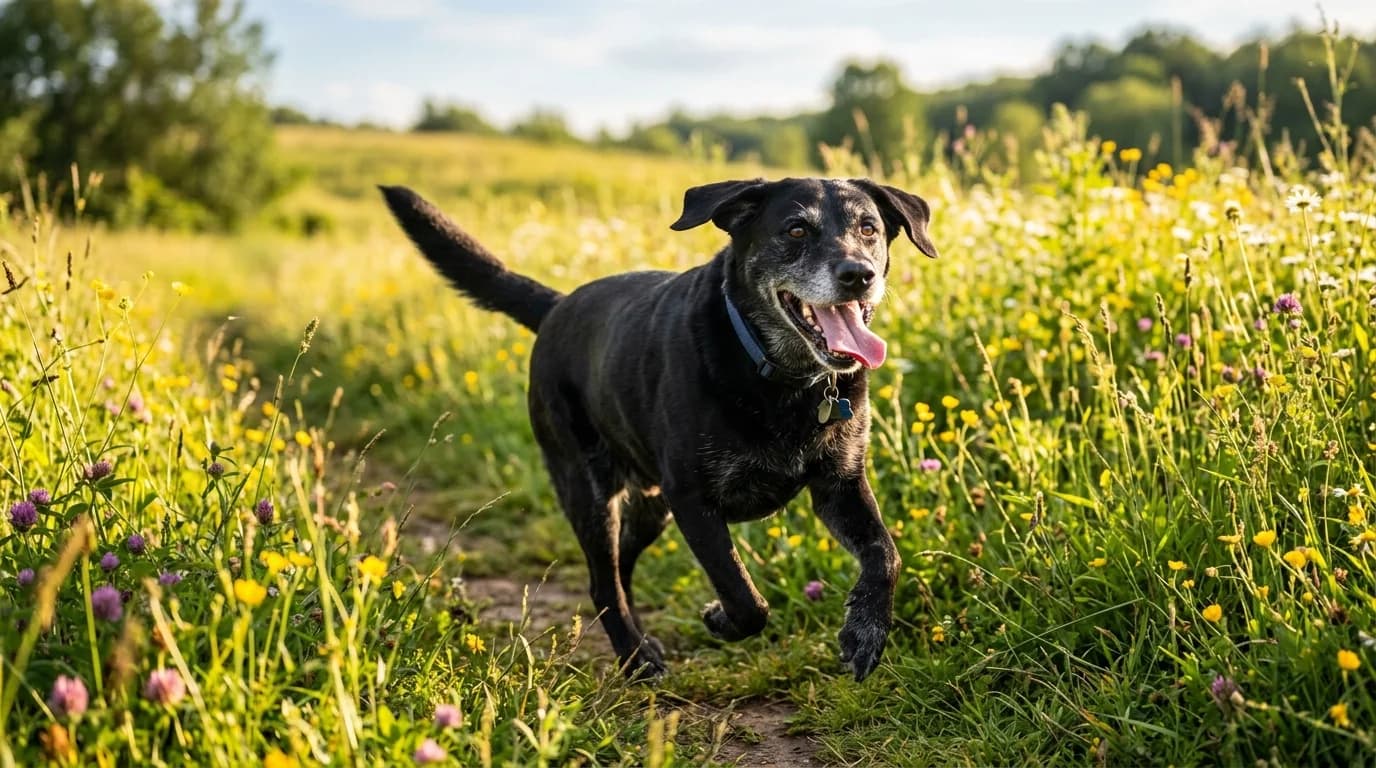
A 10-year-old dog is biologically equivalent to 56 to 78 human years, depending primarily on their adult weight category and breed genetics. While a small dog under 20 pounds (such as a Chihuahua or Toy Poodle) is comparable to a 56-year-old person, a giant breed over 90 pounds (such as a Great Dane or Mastiff) has biologically progressed to approximately 78 human years.
In veterinary clinical practice, age 10 is widely recognized as a pivotal crossroad. According to guidelines established by the American Animal Hospital Association (AAHA), every 10-year-old dog has crossed into the "Senior" or "Geriatric" life stage, demanding proactive preventative healthcare tailored to their physiological age rather than their chronological age.
10-Year-Old Dog to Human Age Conversion by Size
The old adage that "one dog year equals seven human years" fails dramatically when evaluating older pets. Dogs age at an accelerated rate during their first two years of life, after which their aging curve diverges significantly based on physical mass.
The table below breaks down the biological human age equivalent for a 10-year-old dog across different weight classifications:
| Breed Size Category | Typical Weight Range | 10 Dog Years in Human Years | AAHA Life Stage Status | Primary Clinical Screening Focus |
|---|---|---|---|---|
| Small / Toy | Under 20 lbs (<9 kg) | 56 human years | Senior | Mitral valve disease, periodontal health |
| Medium | 21 – 50 lbs (10 – 23 kg) | 60 human years | Senior | Endocrine disorders (Cushing's/Thyroid), arthritis |
| Large | 51 – 90 lbs (24 – 41 kg) | 66 human years | Senior / Geriatric | Osteoarthritis, hip dysplasia, renal function |
| Giant | Over 90 lbs (>41 kg) | 78+ human years | Geriatric | Dilated cardiomyopathy, sarcopenia, mobility |
Note: For an exact calculation tailored to your dog's specific breed profile and target weight, test our interactive Dog Age Calculator or review the complete Dog Age Chart.
Why Biological Aging Varies by Canine Size
Why does a 10-year-old Great Dane show far more cellular wear than a 10-year-old Dachshund?
Large dogs grow from small puppies into massive adults at an astonishing speed. Research published by evolutionary biologists and veterinary geneticists indicates that this rapid early growth causes higher metabolic strain and accelerated cellular senescence. Giant dogs experience elevated oxidative stress and faster telomere shortening, causing their organ systems to age nearly twice as fast as their toy-breed counterparts during the second half of life.
In 2020, geneticists at the University of California, San Diego (Wang et al., Cell Systems) mapped canine DNA methylation patterns against human epigenomes. Their findings confirmed that canine physiological aging is non-linear: dogs age extremely fast in early youth, plateau somewhat during adulthood, and experience organ-specific functional declines that require close veterinary monitoring past age 8 to 10.
Critical Veterinary Screenings for 10-Year-Old Dogs
When a canine patient reaches age 10, the AAHA and the American Veterinary Medical Association (AVMA) recommend switching from annual checkups to bi-annual (every 6 months) wellness examinations.
Key veterinary diagnostic screenings include:
- Comprehensive Blood Chemistry & SDMA: Routine CBC and serum biochemistry panels evaluate liver enzymes (ALT, ALKP) and renal clearance. Testing symmetric dimethylarginine (SDMA) allows veterinarians to detect kidney function loss up to 40% sooner than traditional blood creatinine measurements.
- Mobility & Musculoskeletal Assessment: Over 80% of dogs over age 8 suffer from degenerative joint disease or osteoarthritis. Watch for stiffness after resting, reluctance to climb stairs, and progressive muscle wasting (sarcopenia) along the spine and thighs.
- Blood Pressure & Cardiac Auscultation: Hypertension in older dogs is frequently secondary to chronic kidney disease or endocrinopathies. Regular cardiac listening screens for murmurs and arrhythmia.
- Cognitive Dysfunction Screening (The DISHA Checklist):
Just like humans experience Alzheimer's disease, older dogs can develop Canine Cognitive Dysfunction (CCD). Vets monitor changes using the DISHA acronym:
- Disorientation (staring at walls, getting trapped behind doors)
- Interactions (social withdrawal or clinginess)
- Sleep-wake cycle changes (pacing and whining at night)
- Housetraining breakdowns (accidents indoors)
- Activity level fluctuations (aimless wandering)
Daily Quality of Life Tips for 10-Year-Old Dogs
- Orthopedic Support: Invest in memory foam orthopedic bedding to relieve pressure points on arthritic elbows and hips.
- Non-Slip Flooring: Place yoga mats or rugs over hardwood and tile floors to prevent painful slips and hip dislocations.
- Caloric & Joint Nutrition: Senior dogs require slightly higher protein quality to fight muscle atrophy, alongside proven joint supplements containing EPA/DHA omega-3 fatty acids, glucosamine, and chondroitin.
- Gentle, Consistent Exercise: Replace strenuous high-impact fetch sessions with two to three shorter, low-impact strolls each day to keep joints lubricated without causing post-exercise inflammation.
(Have a multi-pet home? Compare how canines age relative to domestic cats with our Cat Age Calculator.)
Frequently Asked Questions
Is a 10-year-old dog considered geriatric?
It depends on their size. For small and medium dogs (under 50 lbs), age 10 is classified as Senior (roughly equivalent to 56–60 human years). For large and giant breeds (over 50 lbs), age 10 is considered Geriatric (equivalent to 66–78+ human years), representing the final 25% of their expected natural lifespan.
What is the average life expectancy of a dog that has reached age 10?
Small breeds that reach age 10 frequently live to 14–16 years with attentive senior care. Medium dogs typically reach 12–14 years. Large and giant breeds reaching age 10 have already exceeded their typical average lifespan and require close palliative veterinary monitoring.
Should I change my 10-year-old dog's diet?
Yes, unless contraindicated by existing disease. Most 10-year-old dogs benefit from senior-specific formulas with elevated L-carnitine, optimized omega-3 fatty acids for joint and brain health, and easily digestible proteins to preserve lean body mass. Always consult your vet before making dietary transitions.
Clinical Sources & References
- American Animal Hospital Association (AAHA). 2019 AAHA Canine Life Stage Guidelines. Available at: aaha.org
- American Veterinary Medical Association (AVMA). Senior Pet Care FAQ and Management Guidelines. Available at: avma.org
- Wang, T., et al. (2020). Quantitative Translation of Dog-to-Human Aging by Conserved Remodeling of the DNA Methylome. Cell Systems, 11(2), 176–185. [DOI: 10.1016/j.cels.2020.06.006]
Veterinary Medical Disclaimer: This article and its associated conversion tools are created strictly for educational, informational, and reference purposes. Biological aging varies widely between individuals based on genetic lineage, diet, weight control, and chronic disease history. Always consult a licensed Doctor of Veterinary Medicine (DVM) for personalized medical diagnosis, laboratory evaluations, and tailored geriatric care.