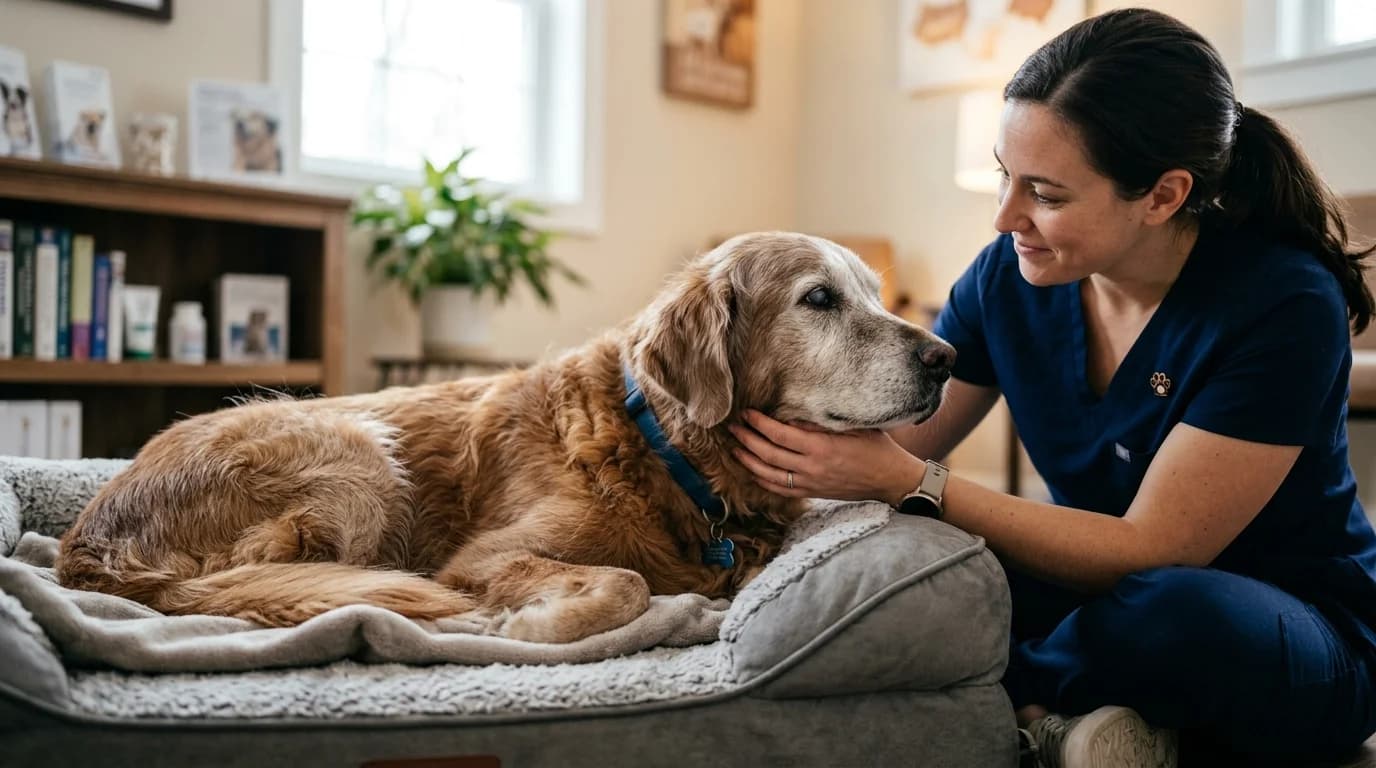
Canine Cognitive Dysfunction (CCD), commonly known as canine dementia or dog Alzheimer's disease, is a progressive neurodegenerative disorder affecting an estimated 28% of dogs aged 11 to 12 years and 68% of dogs aged 15 to 16 years, characterized by cerebral beta-amyloid plaque accumulation, cortical atrophy, and measurable loss of cognitive faculties.
In veterinary clinical practice, routine geriatric screening often detects subtle cognitive markers—such as nocturnal pacing or house-soiling—months before overt disorientation appears. Guardians frequently mistake early signs for "normal aging," delaying medical intervention. Because cognitive decline is a distinct neuropathology rather than inevitable senescence, early differentiation from osteoarthritis pain, hypertension, endocrinopathies, or sensory loss is vital to safeguarding welfare and preserving the human-animal bond.
Senior Life Stages & CCD Vulnerability by Breed Size
Because biological aging rates correlate inversely with adult canine mass, cognitive senescence varies across breeds. Epigenetic research led by UC San Diego and UC Davis (Cell Systems, Wang et al., 2020) demonstrated that canine aging follows a non-linear trajectory driven by rapid juvenile DNA methylation and size-dependent somatic wear.
Giant breeds experience accelerated cellular senescence, crossing the senior threshold by age 5 to 6, whereas toy dogs reach equivalent vulnerability between 10 and 11 years. The table below outlines senior thresholds, cognitive vulnerability windows, and clinical lookalikes across weight categories:
| Breed Size Category | Adult Weight Range | AAHA Senior Entry Age | Typical CCD Vulnerability Window | Human Age Equivalent at CCD Onset | Clinical Lookalikes to Rule Out |
|---|---|---|---|---|---|
| Toy | Under 12 lbs (<5.5 kg) | 10 – 11 years | 13 – 16+ years | 68 – 82+ human yrs | Mitral valve disease, dental pain, cataracts |
| Small | 12 – 25 lbs (5.5 – 11 kg) | 8 – 9 years | 12 – 15 years | 64 – 76 human yrs | Intervertebral disc disease (IVDD), renal disease, presbycusis |
| Medium | 26 – 50 lbs (12 – 23 kg) | 7 – 8 years | 11 – 14 years | 65 – 78 human yrs | Stifle osteoarthritis, hypothyroidism, Cushing's disease |
| Large | 51 – 90 lbs (24 – 41 kg) | 6 – 7 years | 9 – 12 years | 66 – 82 human yrs | Lumbosacral stenosis, brain tumors, hemangiosarcoma |
| Giant | Over 90 lbs (>41 kg) | 5 – 6 years | 7 – 9 years | 62 – 75+ human yrs | Dilated cardiomyopathy, cervical spondylomyelopathy, spondylosis |
To determine your dog's exact biological age and track life stage transitions, use our interactive Dog Age Calculator or explore the comprehensive Dog Age Chart.
The Clinical DISHA Checklist: Diagnosing Canine Dementia
Veterinary behaviorists and the American Animal Hospital Association (AAHA) evaluate senior dogs using the DISHA diagnostic screening framework:
- Disorientation (D): Navigational confusion, such as getting trapped behind doors, staring blankly at walls, or pacing into corners.
- Interactions (I): Social shifts including aloofness, uncharacteristic clinginess, or unprovoked touch irritability.
- Sleep-Wake Cycles (S): Disrupted circadian rhythms causing nocturnal pacing, night vocalization, and heavy daytime stupor.
- House-Soiling (H): Loss of housetraining without primary urinary pathology, such as indoor accidents immediately after outdoor walks.
- Activity Changes (A): Stereotypic behaviors like circular pacing and compulsive licking, or marked apathy and decreased curiosity.
- Anxiety & Learning/Memory (A/L): Spontaneous separation distress, novel noise phobias, or failure to perform long-practiced cues.
Neuropathological Mechanisms: Inside the Aging Canine Brain
Canine Cognitive Dysfunction mirrors human Alzheimer's disease due to shared molecular biology:
- Beta-Amyloid ($\text{A}\beta$) Deposition: Diffuse amyloid plaques accumulate across the cortex and hippocampus, inducing synaptic detachment and microglial neuroinflammation.
- Cerebral Amyloid Angiopathy (CAA): Amyloid infiltration into cerebral vessels causes micro-ischemia and blood-brain barrier disruption.
- Mitochondrial Oxidative Stress: Aging neurons suffer lipid peroxidation and free-radical cascades, causing cellular bioenergetic exhaustion.
- Neurotransmitter Depletion: Overexpression of monoamine oxidase B (MAO-B) accelerates dopamine breakdown, while acetylcholine loss impairs memory retrieval.
Diagnostic Differentiation: Ruling Out Medical Lookalikes
Canine Cognitive Dysfunction is a clinical diagnosis of exclusion requiring evaluation for conditions mimicking DISHA criteria:
- Osteoarthritis & Pain: Joint stiffness causes night restlessness, panting, and house-soiling due to difficulty posturing.
- Sensory Impairment (Presbycusis & Cataracts): Hearing loss and cataracts generate startling and navigation hesitation.
- Endocrine & Renal Disorders: Cushing's disease, diabetes, and kidney failure produce severe polyuria mimicking dementia house-soiling.
- Intracranial Lesions: Forebrain neoplasia (meningiomas, gliomas) or strokes present with compulsive circling and acute behavioral changes.
A standard diagnostic panel requires a complete blood count (CBC), serum chemistry, total T4, urinalysis, blood pressure measurement, and neurological exams.
Evidence-Based Multimodal Senior Dog Management
While neurodegeneration cannot be cured, early multimodal intervention decelerates progression and maintains comfort:
- Pharmacotherapy (Selegiline HCl / L-Deprenyl): An FDA-approved selective MAO-B inhibitor that boosts dopamine levels and provides neuroprotection. Improvements typically appear within 2 to 6 weeks.
- Medium-Chain Triglyceride (MCT) Diets: Diets enriched with botanical MCTs supply ketone bodies as an alternative fuel substrate, bypassing impaired neuronal glucose metabolism.
- Antioxidants & Omega-3s: Diets providing vitamins E and C, selenium, and concentrated EPA/DHA fatty acids diminish neuroinflammation and preserve synaptic fluidity.
- Neuro-Nutraceuticals: S-adenosylmethionine (SAMe), phosphatidylserine, and apoaequorin support neuronal membrane stability and cellular calcium regulation.
- Environmental & Mental Enrichment: Lay non-slip runners over slick floors, maintain fixed routines, add nightlights near sleeping areas, and use gentle snuffle mats to sustain neuroplasticity.
Frequently Asked Questions
Can canine cognitive dysfunction be reversed or cured?
Canine cognitive dysfunction cannot be cured or reversed because it involves permanent structural neuronal loss and beta-amyloid accumulation. However, multimodal therapy combining MAO-B inhibitors, neuroprotective MCT diets, and environmental enrichment can significantly decelerate progression and restore comfort.
How do I tell if my senior dog has dementia or is just losing vision and hearing?
Dogs with isolated sensory deficits navigate familiar home layouts confidently using scent and tactile cues, whereas dogs with dementia get trapped in corners, stare blankly, and reverse their sleep-wake cycles. A comprehensive veterinary exam evaluating cranial nerve reflexes, ophthalmic structures, and behavioral history accurately differentiates the two conditions.
When is it time to consider quality-of-life euthanasia for a dog with dementia?
Euthanasia should be compassionately evaluated when cognitive decline produces intractable anxiety, continuous nocturnal distress, loss of recognized human connection, or an absence of joyful baseline moments. Clinicians recommend evaluating daily comfort using validated hospice scoring tools, such as the HHHHHMM Quality of Life scale, in consultation with your veterinarian.
References & Sources
- American Animal Hospital Association (AAHA). 2023 AAHA Senior Care Guidelines for Dogs and Cats. Available at: aaha.org
- American Veterinary Medical Association (AVMA). Senior Pet Care and Cognitive Dysfunction. Available at: avma.org
- American Kennel Club (AKC) Canine Health Foundation. Dog Dementia: Signs, Symptoms, and Management of Canine Cognitive Dysfunction. Available at: akc.org
- Wang, T., et al. (2020). Quantitative Translation of Dog-to-Human Aging by Conserved Remodeling of Epigenetic Networks. Cell Systems, 11(2), 176–185. Available at: cell.com
Veterinary Medical Disclaimer: This article and calculator are for educational and informational purposes only. Every pet ages differently based on genetics, weight, and environment. Always consult your licensed veterinarian for personalized clinical advice, diagnosis, and senior care screening.